
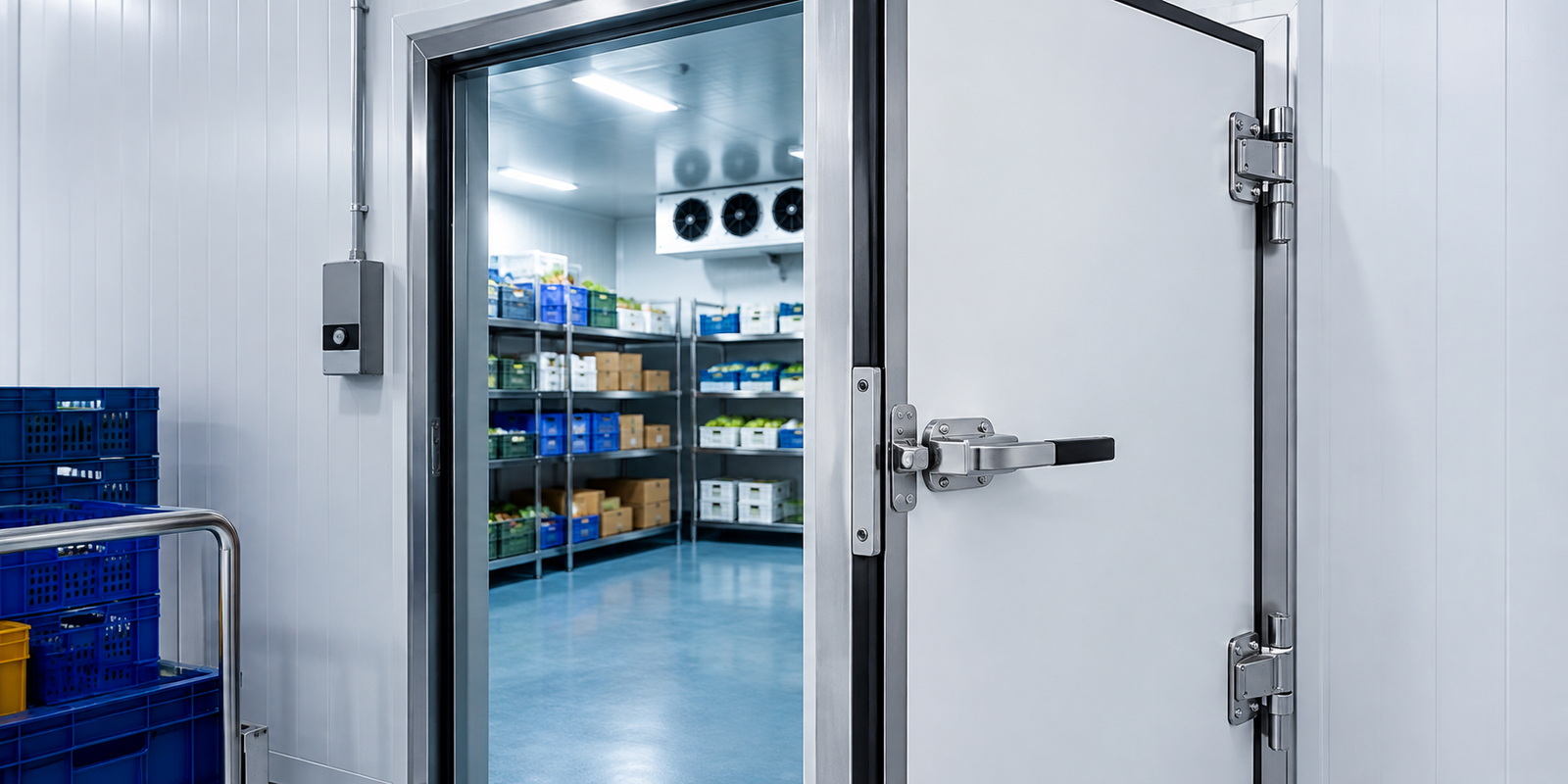

A cold room may be perfectly insulated, refrigerated, and managed in terms of temperature; however, what will happen if a gasket begins to leak, the hinge no longer functions, or the door closer breaks?
Little things can cause great inconveniences.
This is the reason why selecting the appropriate Cold Room Door Supplier requires more than just comparing product prices. The quality, compatibility, availability, and reliability of cold room accessories can have a direct impact on temperature control, efficiency, hygiene, and operations.
Whether you are establishing a new cold storage room or managing an already existing one, the choice of your supplier might have an effect. But what criteria should be taken into consideration before making the order?
Let us consider this question.
Why the Right Cold Room Door Supplier Matters
The doors of cold rooms are subject to fluctuations in temperatures, humidity levels, continuous opening and closing, and challenging conditions of use. The components must resist all this without negatively affecting the functioning of the door.
A reliable Cold Room Door Supplier should not just supply you with a list of components.
What you can demand is:
- Components that match for various uses in cold rooms
- Strong materials that are fit for cold conditions
- Sealing and insulation aid
- Quality products consistently
- Technical support when necessary
- Availability of quality products
- Delivery and after sales services
A supplier who knows the application can also assist you to avoid one mistake: using the component just because it looks good or is cheaper.
1. Quality Check of Cold Room Accessories
Not all hinges, gaskets, locks, handles, or closers are intended for cold storage applications.
The requirements of cold room accessories include reliability in spite of low temperature, humidity, frequent use, and moist conditions. Low-quality hardware will deteriorate sooner and may ultimately impact the performance of the door itself.
Consider the following before selecting a vendor:
- Quality of materials
- Corrosion resistance
- Temperature resistance
- Mechanical properties
- Sealing characteristics
- Lifetime expectancy
- Product uniformity
Insightful point: Though the cheaper accessory looks to be more economical at first glance, there are many possibilities for it being expensive in the long run.
2.Consider Cold Room Door Supplier Having a Large Variety of Products
Think about the necessity of replacing a gasket now, a hinge in a month’s time, and a door closer after that – each occasion meaning a separate supplier call. It soon turns into a nuisance.
Having one supplier who provides a variety of cold room accessories makes things easier. Depending on your needs,
the product range can include:
- Hinges for cold room doors
- Door seals
- Locks and knobs
- Door closers
- Sliding doors accessories
- PVC curtains
- Profiles
- Heating wires
- Spares
- Other door accessories
Having a larger product range also ensures that sourcing components is made simpler from one source.
3. Compatibility Needs to Precede Cost
One of the most neglected aspects when buying any accessories for cold rooms is compatibility.
A particular piece of equipment may be perfectly fine to use but still end up incompatible with the existing door system.
For instance, getting the wrong size of gasket could mean inadequate sealing. The wrong hinge will mean inadequate door positioning, while the wrong door closer will lack adequate closing power.
Before you buy, ensure that:
Door type → Size → Operating temperature → Material → Purpose → Compatibility
A competent Cold Room Door Supplier will assist you in choosing the right part instead of just trying to sell you what is available closest.
4. Assessment of Supplier Knowledge on Cold Room Storage Facilities
The supplier may not be required to design the whole facility for you, but they must know how their products work within the larger context of Cold Room Storage Solutions.
Why is that important?
Because accessories do not work on their own.
The door gasket helps seal the door. The hinge helps with movement and alignment of the door. The door closer ensures the door closes.
And the PVC curtain can limit unwanted air exchange in some situations.
These parts help determine how well the cold room works.
Think Beyond the Individual Product
Rather than asking:
“What type of hinge do I need?”
Ask:
“What type of hinge fits my needs considering this door and its temperature, use, and operating conditions?”
This shift in approach may help you make an excellent buying decision.
5. Confirm Product Availability and Dependable Delivery
But the problem with a faulty cold room part is not always one you want to wait several weeks for.
A critical door fitting failure will affect your operations and might even expose your temperature-sensitive goods to danger.
That is why you should inquire about:
- Stock availability
- Delivery times
- Availability of replacement parts
- Bulk ordering
- Emergency needs
- Shipping alternatives
For a business running more than one cold room or storage facility, the presence of a reliable supplier becomes extremely beneficial.
6. Comparison of Technical Support, Not Product Prices Only
Two vendors can sell identical-looking items for various amounts. However, just looking at the price does not reveal which product suits your needs better.
Consider this simple comparison:
In comparison between different suppliers, it is quite obvious that there is always a distinction between a price-driven supplier and an application-based supplier. For example, the price-driven supplier is likely to have fewer products to choose from, less compatibility information to give, and poor technical support. As for spare parts and service and support in general, they can differ too. The application-based supplier will most likely offer a wide choice of products, better compatibility data, and technical support tailored specifically to the needs of the cold room. As for spare parts, they will probably be available more easily, and service and support will be considered as key points.
The second approach can be particularly useful when the accessory is critical to cold room performance.
7. Enquire Regarding Customization and Project Specifications
Not all cold storage projects share identical specifications.
A restaurant cold room, a pharmaceutical cold storage facility, a food processing center, and a large warehouse may have vastly differing requirements.
Your Cold Room Door Supplier must be prepared to comprehend your project before making recommendations on parts.
Find out if they can provide:
- Various door sizes
- Different temperatures specifications
- Heavy duty conditions
- Sliding and hinge type doors
- Replacing and retrofitting needs
- Bulk commercial projects
- Special hardware needs
The skill of communicating application-related requirements may be more important than the possession of an extensive product range.
8. Corrosion Resistance and Materials Should Not Be Overlooked
Condensation and moisture problems are common in cold rooms. In harsh conditions, wrong materials can result in corrosion, decay, or diminished functionality.
Selection of materials is very critical.
In the comparison of accessories, the suitability of the materials to:
- High moisture content
- Cold temperature
- Cleaning often
- Food uses
- Usage frequency
Sometimes the environment in which the accessory is used may carry as much importance as the specifications of the accessory itself.
9. Think of Post-sales Service
This is not to say that the partnership should cease at the point of issuing the invoice.
What would happen if there was the need for a replacement part in six months’ time?
What if there were problems installing the item?
What if the component failed to function properly?
These are practical concerns that one might want to consider before deciding on a particular supplier.
The best supplier will be the one who offers good communication, products, replacements, and after-sales services.
This is particularly crucial for companies running vital cold storage facilities.
10. A Simple Checklist Before Choosing a Cold Room Door Supplier
Before finalizing your supplier, run through this checklist:
- Does the supplier provide high-quality accessories for the cold room?
- Does the product have the ability to operate in low temperatures?
- Is the material suitable for the job?
- Does the supplier assure that the product is compatible?
- Are spare parts easily available?
- Does the supplier have different types of accessories?
- Can they meet commercial requirements?
- Is technical support available?
- Is the delivery time assured?
In case some of these queries are left unanswered, then perhaps it would be wise to give the supplier some thought.
Cold Room Accessories Supplier and General Hardware Supplier Comparison
It is easy to want to buy cold room parts from a regular hardware shop, mainly because the cost can look good.
Still, there is a key point that matters.
A regular hardware seller often stocks common items. A cold room door specialist is more likely to know how these doors work in real use. They also tend to match parts to the right setup and the right expectations for cold storage.
This matters most when the part can change how well the door seals, how insulation holds up, how the door moves, or how well the temperature stays steady.
You might be asking, “Where can I buy it?” but that is not the main point.
Try this instead:
“Who can supply the right part for my cold room?”
This moves the conversation away from quick buying and toward steady results over time.
Making the Right Choice for Your Cold Room
Picking items for a cold room can be simple. First, look at how your door works. Also note the target temperature, how often the door is used, and what the room is like day to day. Check what kind of upkeep you can handle.
Next, compare suppliers. Look at build quality, fit with your door system, and the choices they offer. Make sure items are easy to get. Ask about their technical help and what they do after the sale.
A good supplier should not just email a catalog. They should help you choose parts that fit your exact use.
Cold room storage depends on many pieces that work as a set. The door is only part of that. The related accessories still shape how the system runs in real life.
Conclusion
A good cold room door supplier is not only about hinges, gaskets, locks, and other parts. The right team can also help you pick components that fit together. They can keep the door working well over time. They may also help you avoid extra service calls and reduce maintenance headaches. In the end, they support the day to day running of your cold storage space.
So do not judge suppliers by cost alone.
Start with simple checks. Do the parts last? Do they match each other? Is help available if you run into a problem? When a part breaks, can you get a replacement fast? Does the supplier know how cold storage doors are used?
These details often matter more than a price list.
When your cold room must run reliably, the right accessories and the right supplier can be a decision you get right from the start, Barad Atlanta Trading LLC
Frequently Asked Question
1. What should I look for in a Cold Room Door Supplier?
Look for product quality, compatibility, material suitability, availability, technical support, replacement parts, reliable delivery, and after-sales service.
2. Why is compatibility important when choosing cold room accessories?
Compatible accessories help ensure proper door operation, sealing, alignment, and long-term performance. The correct component should match the door type, dimensions, temperature range, and application.
3. What accessories are commonly required for cold room doors?
Common accessories include hinges, gaskets, locks, handles, door closers, sliding door components, PVC curtains, profiles, and heating cables.
4. How do cold room accessories support Cold Room Storage Solutions?
Components such as gaskets, hinges, closers, and curtains can support proper sealing, door operation, and temperature management, contributing to more effective cold storage operations.
5. Should I choose a specialist Cold Room Door Supplier or a general hardware supplier?
For cold storage applications, it is useful to consider a supplier with specific knowledge of cold room doors and accessories. Application knowledge can help with compatibility, material selection, replacement parts, and technical requirements.